In our previous blog, Non-Human Identities: A Dr Jekyll and Mr Hyde Story for Enterprise Security, we explored why non-human identities have become a critical security, governance and trust challenge, and why identity now sits at the centre of successful AI adoption.
As organisations embrace automation, cloud services and agentic AI, non-human identities are becoming central to how the modern enterprise operates. They connect applications, execute workflows, support integrations, trigger processes, consume data and increasingly make decisions on behalf of the business.
They are no longer a niche technical concern buried inside infrastructure teams. They are becoming a major identity, security and governance challenge.
The question is no longer whether organisations will deploy AI agents and other non-human identities. They inevitably will. The challenge is ensuring that they operate within clearly defined boundaries, with the visibility, governance and oversight required to maintain trust.
Why securing non-human identities requires a new approach to identity governance
The rise of agentic AI is changing the nature of identity risk. Understanding who created an AI agent is no longer enough. Organisations need to understand what it can access, what actions it is authorised to perform, what data it consumes and generates, how it behaves in practice, and whether it continues to operate within its intended purpose.
This requires a new approach that combines identity governance, observability, behavioural analysis, and continuous monitoring.
Traditional lifecycle management remains important, but it is no longer sufficient on its own. Organisations need continuous insight into how non-human identities behave, exercise privileges, interact with data, and influence business processes across the enterprise.
In some organisations, non-human identities already outnumber human identities by a factor of 10:1. As AI adoption accelerates, many expect that ratio to exceed 100:1. Organisations are therefore facing not just a larger identity problem, but a fundamentally different one.
Unlike human users, non-human identities have distinct lifecycle models, ownership structures and governance requirements. Traditional identity programmes were designed around relatively static human accounts. AI agents, service accounts, workload identities and machine credentials operate differently, requiring organisations to understand not only what access they have, but how that access is being used, whether it remains appropriate, and whether behaviour stays within expected operational boundaries.
A practical approach to governing non-human identities should therefore focus on four key areas:
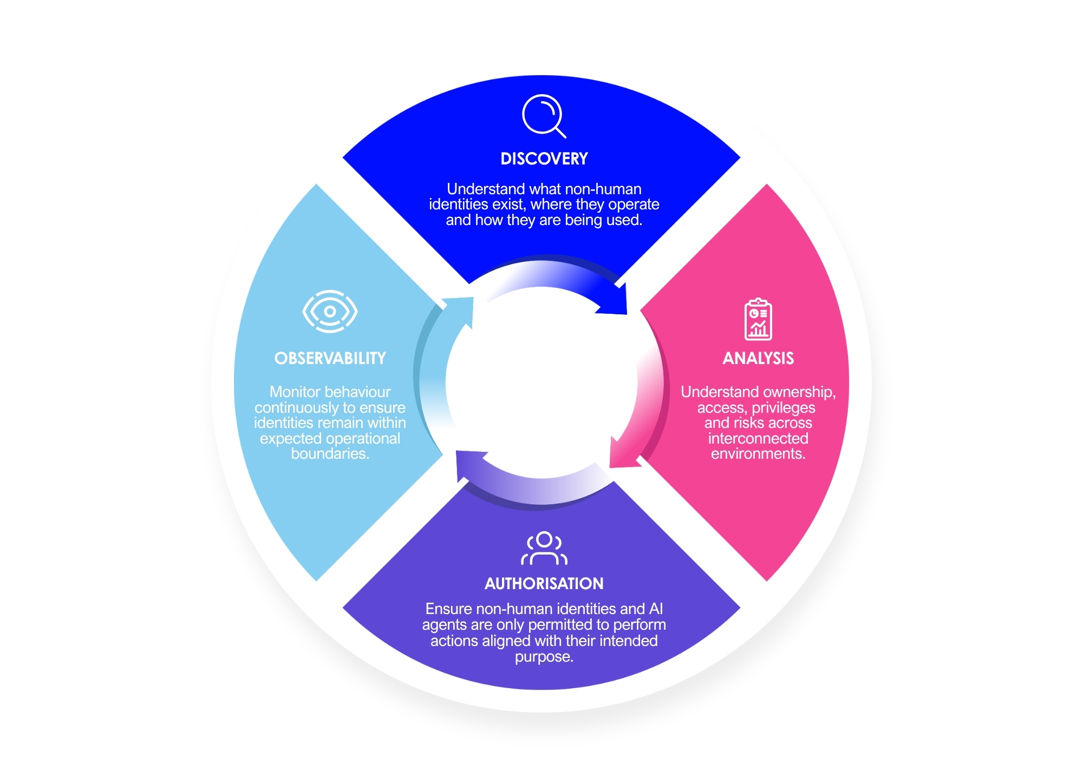
The rest of this article explores these areas in more detail and examines the practical considerations organisations should address when securing the new digital workforce.
Why traditional IAM controls are not enough for AI agents and non-human identities
Historically, identity solutions integrated with business applications to provide visibility of static accounts and access. This helped organisations understand what an identity could do, but it rarely provided meaningful insight into what the identity actually did.
For many organisations, understanding how privileges were actually being exercised remained largely the responsibility of security operations teams. As a result, visibility into whether access was being used appropriately, or whether behaviour had drifted beyond its intended purpose, was often limited.
That distinction is critical in the world of agentic AI.
Traditional IAM is focused on understanding what an identity could do. Securing AI agents requires understanding of what an identity is doing.
Knowing what an AI agent can access is important. Knowing what the agent is actually doing, is essential. Without that understanding, organisations have limited visibility into how privileges are being exercised, whether access is being used appropriately, or whether an identity’s behaviour has drifted beyond its intended purpose.
Start with non-human identity discovery
The first challenge is visibility.
Organisations need the ability to continuously discover AI agents, non-human identities, service accounts, API keys, workload identities, and other machine credentials operating across the enterprise. Unlike human identities, non-human identities often have different ownership models, lifecycles, and governance requirements. Discovery is therefore not simply about creating an inventory. It is about understanding how these identities are created, used, managed, and eventually retired.
This includes identifying unauthorised or shadow AI deployments that may be accessing corporate systems, data or services without formal governance.
Discovery capabilities also need to align more closely with Security Operations Centres, providing continuous identification of new identities, credentials and access paths as they emerge.
This discovery process should establish:
- What identities exist
- Who owns them
- What they can access
- How secrets are managed
- How they are governed throughout their lifecycle
Without these answers, organisations are left trying to govern identities they cannot see, and control access they do not fully understand.
Analyse access and privileges, not just non-human identity accounts
Visibility alone is not enough. Organisations also need to analyse how non-human identities are used across their environment and establish appropriate governance controls. This includes understanding what access an identity possesses, how frequently it is used, whether its privileges align with its intended business purpose, who is accountable for the identity, and whether excessive permissions exist.
Particular attention should be given to access chaining, where entitlements span multiple systems through nested groups, delegated permissions, API relationships, cloud roles and interconnected AI services.
In complex AI ecosystems, privilege accumulation across these chains can create significant risk. It can also remain invisible without detailed analysis.
An AI agent may be technically capable of performing an action, but that does not necessarily mean it should be authorised to do so. This is where the principle of least privilege needs to evolve. For AI agents, organisations may need to think in terms of "least agency": granting agents only the permissions, autonomy and decision-making authority required for a specific task, context and operating condition.
Move from periodic access reviews to continuous identity observability
Static governance is no longer sufficient. Discovery, analysis and authorisation provide the foundation. Observability provides assurance.
AI agents operate dynamically, often making decisions and initiating actions continuously. Organisations therefore need observability capabilities that provide real-time insight into identity behaviour, access utilisation and agent activity. This includes monitoring identity activity, detecting anomalous behaviour, identifying excessive privilege usage, discovering unauthorised access attempts, and detecting actions occurring outside expected operational patterns.
The ability to correlate non-human identity activity with wider security telemetry will become increasingly important as organisations seek to distinguish normal AI behaviour from potential misuse or compromise.
Observability also provides a mechanism for detecting behavioural drift over time. An AI agent may begin operating within its intended parameters but gradually expand its activity as integrations evolve, permissions accumulate, or underlying models change. Continuous monitoring helps organisations identify when behaviour starts to diverge from expectations, providing ongoing assurance that non-human identities remain aligned with their intended purpose.
Keep humans accountable for AI agents and non-human identities
Most organisations currently assign human owners to non-human identities and hold them accountable for lifecycle management, access reviews and governance activities.
With agentic AI, accountability becomes more complex. An AI agent’s behaviour may be influenced by its underlying model, training data, connected systems, external services and evolving instructions, many of which may sit outside the direct control of the designated owner.
As a result, legal, compliance, risk and security teams will need to work together to define appropriate policies, operating models, accountability structures and RACI frameworks for AI-enabled services.
For high-risk actions involving sensitive data, financial transactions, privileged operations or critical decisions, organisations should also consider human-in-the-loop controls. This provides an additional layer of oversight where autonomous decision-making may introduce unacceptable risk.
Prepare for proxy access and delegated authority
Agentic AI also introduces new forms of delegation. A digital assistant may need to interact with calendars, email systems, booking platforms, expense tools or financial applications on behalf of a user. To do that, it may require delegated access for a defined period of time.
This introduces the need for robust proxy and delegation models, ensuring that user consent is explicit, permissions are time-bound, actions are traceable, approval mechanisms exist where necessary, and access is automatically revoked when no longer required.
This is a critical governance issue. If AI agents are going to act on behalf of users, organisations need to know when they are acting, what authority they have, and where that authority begins and ends.
Discovery, analysis, authorisation and observability provide the governance foundations for managing non-human identities. The next challenge is translating these principles into operational practices that can be embedded across the organisation. Security leaders can begin by focusing on six practical priorities.
Six priorities for governing non-human identities
There is no simple "deploy a tool and you are done" solution to non-human identity security. The right approach depends on business requirements, regulatory obligations, risk appetite, operating model, technology landscape, and AI use cases.
However, security leaders can focus on six practical priorities:
1. Establish the foundations
Define a clear non-human identity strategy, assign ownership and accountability, implement policy guardrails, enforce least privilege and continuously monitor identity activity.
2. Improve visibility and analysis
Develop discovery and analysis capabilities that surface unknown identities, access paths, trust chains, excessive privileges and anomalous activity across applications, platforms and AI ecosystems.
3. Bring IAM and SOC teams closer together
Integrate identity intelligence into security monitoring and operational response so that suspicious behaviour, privilege misuse and governance risks can be identified and addressed more effectively.
4. Assess the security controls within your AI ecosystem
Understand the identity, authorisation, monitoring, audit and compliance capabilities available across AI platforms, orchestration frameworks and agent ecosystems.
5. Continuously review and test controls
AI platforms are evolving rapidly. Governance and security controls cannot be assessed once and forgotten. Regularly review platform updates, new capabilities and changes in risk exposure.
6. Build an integrated identity ecosystem
Most IAM vendors are rapidly extending their capabilities into AI security and non-human identity governance. No single platform is likely to address every requirement, so organisations should take an ecosystem-based approach aligned to their operating model and risk profile.
Effective non-human identity governance enables trusted AI adoption
Securing AI agents is fundamentally an identity challenge. As organisations embrace agentic AI, they must move beyond static account inventories and periodic entitlement reviews towards continuous discovery, authorisation, observability and governance of non-human identities.
The objective is not to eliminate non-human identities. That would be impossible. The objective is to make them visible, governable and scalable.
Organisations should be able to support experimentation without accepting blind risk, accelerate adoption without sacrificing control, and drive innovation without compromising accountability.
That is the real opportunity. The organisations that succeed with AI will not be those willing to tolerate the most risk. They will be those that can innovate with confidence because they understand, govern and continuously monitor the digital workforce operating across their environment.
AI adoption and identity governance should not be viewed as competing priorities. Effective governance creates the trust that enables organisations to move faster, scale safely and realise value from AI with confidence.
Visibility enables governance. Governance enables trust. Trust enables adoption.

Global VP Identity & Access Management, NCC Group
Derek is a seasoned technology executive with over 26 years of experience in information security, consulting, product management, and professional services. As a global digital identity leader, he oversees the strategy and execution of Identity and Access Management (IAM) and Privileged Access Management (PAM) services, providing thought leadership and insights across enterprise delivery projects.
Throughout his career, Derek has held leadership roles at prestigious organizations, including titles like EMEA IAM Leader at IBM and the UK IAM Leader at PwC. He also founded a boutique IAM service provider, Praxism. A highly respected voice in the digital identity field, Derek actively invests his time in supporting a wide range of industry bodies and organizations.
Build trust in your digital workforce
Gain visibility into human and non-human identities, understand where risk exists, and establish the controls needed to support secure AI adoption.