The API-driven telecom landscape
In the last few years, Application Programming Interfaces (APIs) have become the backbone of modern telecommunication networks — powering everything from customer-facing apps to internal operational systems.
API adoption has exploded as 5G rolls out and telco organizations embrace new revenue streams.
And so have the risks.
Recent breaches highlight a critical reality: APIs are now prime targets for cybercriminals. The consequences go beyond data loss — they damage trust, disrupt services, and attract scrutiny from the regulators while also exposing vulnerabilities across the wider supply chain.
For telco operators, securing APIs has shifted from a “best practice” to a non-negotiable.
The telecom industry’s move towards open, programmable networks has created unprecedented opportunities. Industry initiatives like CAMARA, which standardizes network APIs for developers, are accelerating innovation.
5G, with its promise of ultra-low latency and massive IoT connectivity, is increasing reliance on APIs even further — not just internally, but across partner and third-party ecosystems.
Examples in action:
- India’s 5G telemedicine project leverages APIs for secure video consultations, patient data sharing, and real-time diagnostics.
- Singtel’s API platform enables partners to integrate telco services directly into their applications, creating new revenue streams and faster go-to-market cycles.
The benefits are clear, yes, but so are the attack surfaces.
The cost of API vulnerabilities in the telecom sector
Telecom APIs present unique challenges compared to traditional web apps. They often:
- Handle highly sensitive customer data
- Integrate with legacy systems
- Operate in high-availability environments
- Connect to multiple third-party services
When these APIs are used without robust security controls, attackers can exploit them in ways that bypass traditional defenses.
Common API security risks for telecommunication providers
API security in telecoms goes beyond protecting typical business data, as it may involve safeguarding sensitive information like customer PII, detailed location data, and unique identifiers such as phone numbers.
Unlike general web application security, which focuses on threats to the application interface and backend, API security protects machine-to-machine data exchanges with strong authentication, fine-grained authorization, and strict endpoint control.
APIs are highly exposed to risks defined by OWASP, like broken object-level authorization (BOLA), mass assignment, insufficient logging, and security misconfiguration, which can directly expose core application functions. Attackers may reverse-engineer apps, exploit insecure documentation, or automate API abuse using bots, leading to account takeovers, data scraping, or DDoS attacks.
Effective API security for telecoms requires endpoint-level access control, continuous monitoring, accurate differentiation of legitimate vs malicious traffic, rate limiting, and security validation of all third-party APIs.
Lessons from the front lines
Recent incidents illustrate how these risks play out in the real world:
• Australian telco breach (2022): Exploited a poorly secured API to access customer data, impacting over 10 million accounts.
• T-Mobile breaches (2020–2023): Multiple API vulnerabilities exposed customer account information and personal identifiers.
• IoT device management API compromise: Attackers leveraged insufficient access controls to manipulate device configurations at scale.
Each case underscores the same point: APIs are not a peripheral concern. They are the network’s critical arteries — and if compromised, the fallout is rapid and severe.
Inside the telecom API attack surface
In this second part, we’ll examine how telecom providers can build robust, end-to-end API security into their networks. We cover practical principles for securing APIs, integrating security into the development lifecycle, and ensuring resilience against evolving threats.
Let’s look under the hood at three real-world API vulnerabilities discovered in telecom environments. Each example shows how small oversights can create big openings for exploitation.
1. Server-Side Request Forgery (SSRF)
The risk: SSRF allows an attacker to trick an API into sending requests to unintended destinations — including internal systems or services usually hidden behind a firewall. In a telecom environment, this can expose network management interfaces or internal databases, giving attackers access to sensitive operational data.
Real-world example:
As illustrated below, Server-Side Request Forgery (SSRF) can allow an attacker to trick an API into making requests to unauthorized internal or local network destinations, bypassing security boundaries. In this case, for an OSS/BSS application, a coding flaw enabled the injection of a # character to bypass hardcoded endpoints and force arbitrary URL requests. In this case, even though the API returned a “400 Bad Request” error, the request still reached the target system, proof that it could be exploited. Mitigation requires strict input validation and enforcing a whitelist of permitted destination URLs or hostnames.
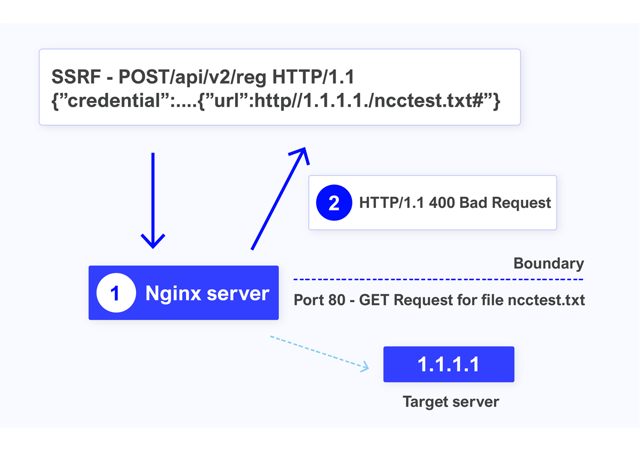
The lesson: Restrict outbound requests to a whitelist of approved URLs or hostnames, and validate inputs before they are processed.
2. Broken authentication
The risk: Poorly implemented authentication allows attackers to assume another user’s identity temporarily or permanently.
Real-world example:
A telecom management OSS/BSS application allowed password changes through a normal UI process, requiring the current password. But an alternative API endpoint skipped that check entirely. By hijacking a legitimate session, an attacker could change the password without knowing the old one, even bypassing complexity requirements. By modifying this data, attackers could escalate privileges, bypass password complexity rules, set weak passwords, and even lock other users’ accounts, including administrators, resulting in broken access control and potential denial-of-service against legitimate users.
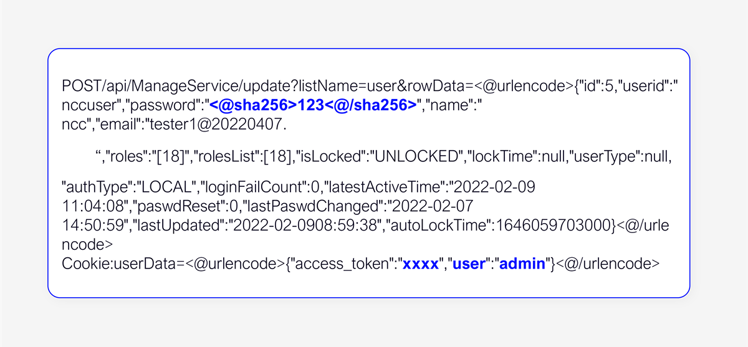
The lesson: Always validate the authenticity of the requesting user, even for secondary API endpoints, and enforce password complexity rules consistently across all interfaces.
3. Broken access control
The risk: Weak access controls let attackers view or modify data outside their permissions.
Real-world example:
A “viewer” role in a telecoms management API should only have been able to see basic network interface data. However, the same API also responded to their requests for highly sensitive configuration details, including AWS access keys normally reserved for admins.
Even if authentication is solid, flawed authorization logic can let users access data or functions they shouldn’t. This management system API failed to enforce proper role-based access control, allowing low-privilege “viewer” accounts to access sensitive functions, such as network configuration, AWS key settings, and system service configuration, intended only for administrators.
By directly calling an alternate API service on a different port, a viewer user could retrieve AWS access keys, bypassing intended UI restrictions. Such exposure could enable privilege escalation and potential lateral movement within the AWS environment hosting the telecoms 5G core network.
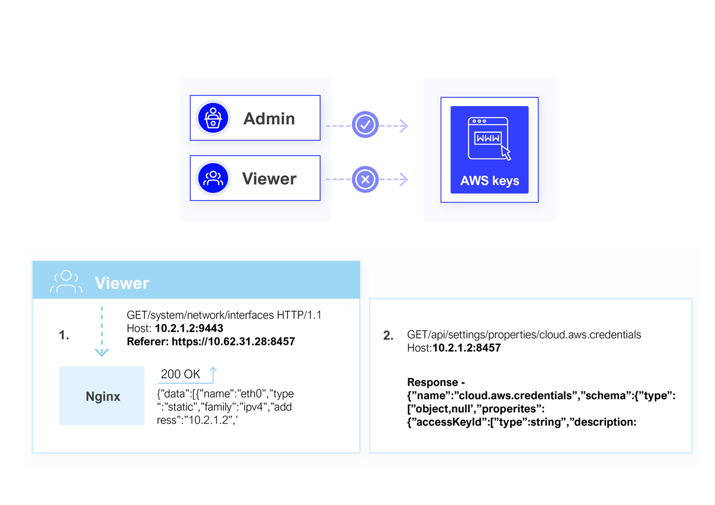
The lesson: Apply field-level and role-based access control checks on every request. Never assume the UI alone will enforce the rules.
Building robust API security in telecoms
One clear pattern emerges from these examples: telecom API security requires continuous testing, layered defenses, and role-aware design.
Core principles include:
• Continuous discovery of all APIs, including shadow/undocumented ones.
• Runtime protection against known and zero-day threats.
• Zero trust access controls — both internal and external.
• AI/ML-powered anomaly detection.
• Compliance alignment (GDPR, NIS2, telecom-specific regulations such as the Telecommunications Security Act).
As 5G, edge computing, and API-driven services expand, the attack surface grows. However, your organization can take action using a robust CI/CD pipeline with SAST / DAST implemented correctly to detect common issues. Building security into every stage of the API lifecycle — from design to production — is the only way to protect customer data, ensure network resilience, and maintain trust.
"Additionally, government agencies and regulators are taking a growing interest in the security of APIs. The most recent example are the proposed updates to the UK Telecommunications Security Code of Practice which now includes API-specific guidance and requirements."
This underlines that securing APIs is not just a technical imperative but also a regulatory one, with implications for resilience across the wider supply chain.
How NCC Group secures APIs
NCC Group provides robust API discovery posture management and runtime protection tailored for telco environments, supporting compliance and operational resilience.
By simulating real-world attacks, NCC Group identifies vulnerabilities in authentication, authorization, and data exposure specific to telecom needs. Our consultants are well-established as industry experts with extensive knowledge of API security.
NCC Group also helps our clients embed security into the entire Software Development Lifecycle (SDLC), using automated checks like static analysis and dynamic testing within CI/CD. With strict access controls and continuous monitoring, we help telecom vendors deliver secure, compliant, and agile API services.

Consulting & Implementation Managing Consultant, NCC Group UK
Philip Marsden is a security consultant specializing in penetration testing for mobile and fixed-line networks since 2019. He works closely with global telecom providers and government agencies to assess vulnerabilities in complex environments such as OpenRAN, subsea cable systems, and 4G/5G core networks.
As a member of the GSMA Fraud and Security Working Group, he contributes to industry-wide threat intelligence and guidance. Philip also develops exploitation code and custom security tools informed by deep expertise in telecom architecture and adversary tactics.
Ready to strengthen your API security?
Contact NCC Group today to safeguard your network and stay ahead of emerging threats.